mistakes to avoid
Who owns the copyright when I scan a client's old studio portraits and wedding photos?
Copyright in a professional portrait usually stays with the photographer or studio, not the family who owns the print. Here is how that shapes what you scan, what you deliver, and what you refuse.
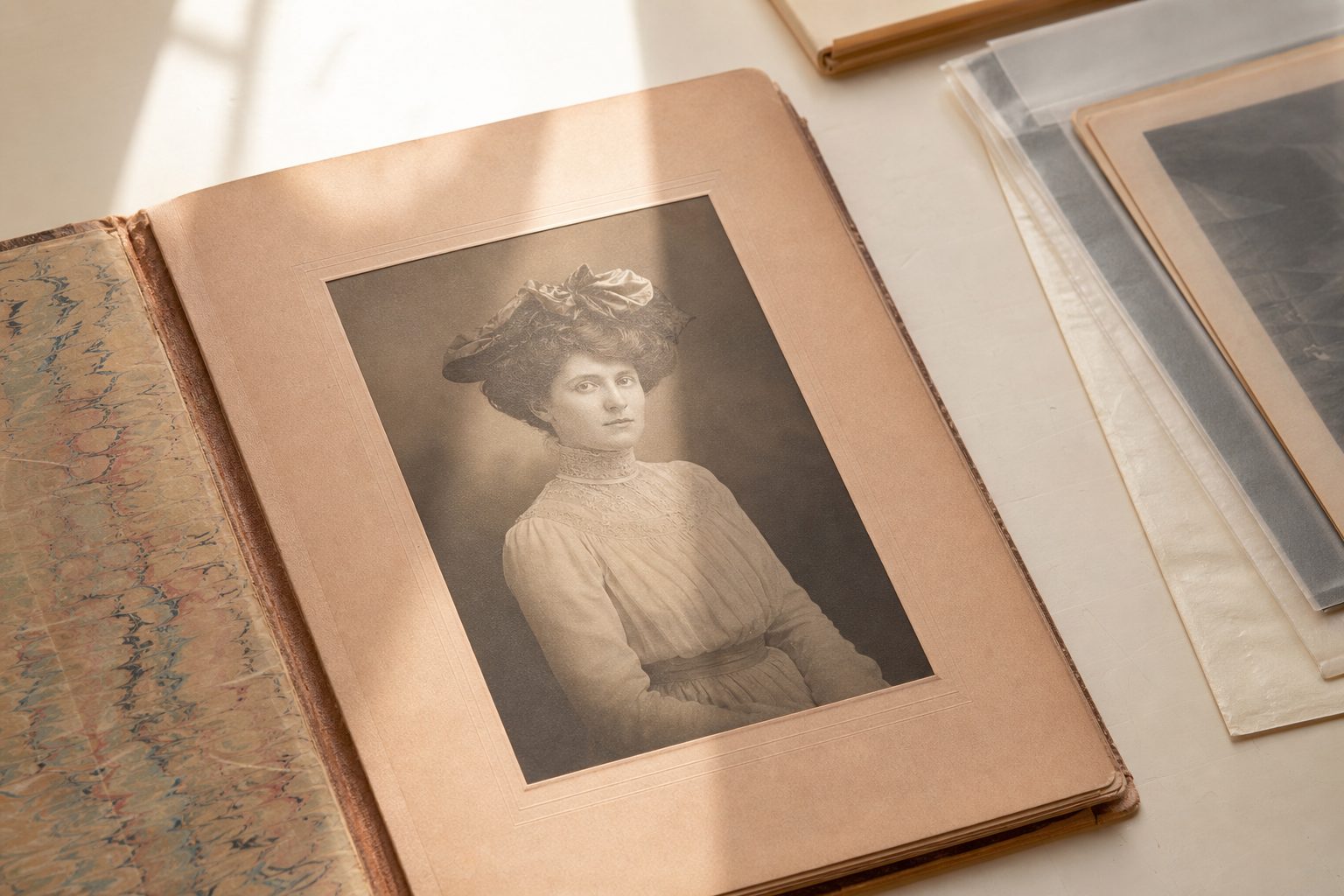
In almost every case, the copyright in a professional studio portrait belongs to the photographer or the studio that made it, not to the family that paid for the sitting and has kept the print in a drawer for sixty years. Buying a print buys the print. Under US copyright law, transferring ownership of a physical copy does not transfer any of the rights in the underlying work, and a transfer of copyright has to be in a signed writing.
There are two big exceptions worth knowing before you panic. Many of the images in a family's oldest boxes are in the public domain because of their age, and a portrait made under a genuine work made for hire arrangement may belong to whoever commissioned it, though that is far rarer than clients believe.
What that means for a memory keeping studio is narrower than it sounds. You are performing a service on your client's property, at your client's direction, and the practical risk in reproducing a protected portrait sits mostly with the family. Your job is to know where the line is, put the representation where it belongs, and recognize the handful of requests you should decline.
Owning a print is not owning the copyright
Two separate property interests exist in every photograph. There is the physical object, the piece of paper with the emulsion on it, and there is the copyright, the bundle of exclusive rights to reproduce, distribute, display, and make derivative works. They travel independently.
The Copyright Act is explicit that owning a material object does not by itself convey rights in the work embodied in it. So the 1962 wedding album on the client's dining table is hers absolutely, and the right to make copies of the images inside it may still belong to a studio that closed in 1988.
Clients find this surprising, and the surprise usually arrives as "we paid for those, they are ours." Have a short, non lecturing answer ready: the album is definitely yours, the copying rights usually stayed with the studio, and for most family work that distinction rarely causes trouble, but here is where it can.
Work made for hire, and why it seldom applies
Copyright can vest in the commissioning party when the work is made for hire. For an outside photographer, that requires both a written agreement signed by both parties calling it a work made for hire, and the work falling into one of the statutory categories of specially commissioned works. A portrait sitting for a private family generally does not fit those categories, and there is almost never a signed writing from 1958 in the box.
Employment is different. A photograph made by a staff photographer within the scope of employment is a work made for hire owned by the employer, which is why the copyright in a newspaper or corporate image usually sits with the organization rather than the person who pressed the shutter.
Keep reading: How should I name files and tag people so a family can still search the archive in twenty years?
Duration basics and why very old images often are not protected
Duration under US law depends on when and whether the work was published, and the rules changed several times. A rough working frame for the material that actually appears in family boxes:
| Situation | General position |
|---|---|
| Published in the US before 1930 | Public domain. This date moves forward by one year every January 1. |
| Published 1930 to 1963 without renewal | Frequently public domain, since renewal was required and often not filed |
| Published 1930 to 1977 with no copyright notice | Often public domain under the notice rules then in force |
| Unpublished works by a known author | Generally life of the author plus 70 years |
| Created 1978 onward | Life plus 70 years, or for anonymous and work made for hire, 95 years from publication or 120 from creation, whichever expires first |
Two cautions. First, "published" is a term of art in copyright, and whether handing prints to a client counted as publication is a question lawyers argue about. Second, none of the pre 1978 rules are safe to apply from memory. Treat the table as a map of which questions to ask, not as a clearance decision.
The practical takeaway is still useful. The tintypes, cabinet cards, and studio portraits from the 1890s and 1910s that make up the emotional core of most family archives are overwhelmingly out of copyright, and nobody needs to lose sleep over scanning them.
Studio marks, school photos, and yearbook images you will meet
You will handle four recognizable categories over and over.
- Mounted studio portraits with an embossed or printed studio name. Often a local business, long closed. The mark tells you who the original claimant was and roughly when.
- School portraits and class composites. Made by regional or national school photography companies. Some of those companies still exist, and some still assert rights on packets from the 1970s and 1980s.
- Yearbook pages. A compilation with its own layer of rights, plus the individual portraits inside it, plus a school or district that may hold or claim something.
- Wedding albums. Often the most emotionally important and the most likely to carry a stamp on the back reading something like "reproduction prohibited."
That stamped warning is not a legal determination, and it may sit on an image whose protection expired decades ago. Treat it as a flag: note it in the project record rather than quietly ignoring it.
Copy negatives and restoration work
Two related points that come up in this trade. A straightforward scan of a flat photograph is generally treated as a faithful reproduction rather than a new copyrightable work, so scanning does not create a new copyright you can claim. And substantial digital restoration of a protected image can amount to a derivative work, which is one of the rights held by the copyright owner. Heavy restoration of a recent protected portrait deserves more thought than a dust spot removal on a 1912 cabinet card.
Keep reading: Why do my clients keep stalling at the sorting stage, and how do I move the project forward?
What a release from the family can and cannot do for you
Get a written representation from your client. It is worth having. Just be honest with yourself about what it does.
It can record that the client asked for the work, that she represents she has the right to request it, and that she will indemnify you if that representation turns out to be wrong. It shifts allocation of risk between you and her, and it evidences good faith.
It cannot grant rights the client never had. A family cannot license a studio's copyright to you by signing your form. If the studio's successor ever objected, your client's signature does not make the reproduction authorized. It only determines who bears the cost of the dispute.
Indemnities are also only as good as the person signing them. A retired client with limited assets can sign a fine indemnity clause that will never pay a legal bill. That is a reason to decline unreasonable requests rather than paper over them.
Common requests to decline, and how to decline them well
Most of your work is a family reproducing family images for family use. That is low risk. A short list of requests deserves a different answer:
- Bulk reproduction of recent school packets for resale or fundraising. Commercial redistribution of a company's current product is the clearest problem on this list.
- Scanning a yearbook cover to cover for public posting. Volume plus publication plus a live compilation copyright.
- Removing a studio mark or a photographer's signature from the image. Beyond the copyright question, deliberately stripping identifying information from a work raises its own issues under federal law.
- Producing a large print run of a recent wedding portrait for sale at an event. Volume and commerce again.
- Anything a working photographer has already refused in writing. If the client shows you a denial email, that is the end of the conversation.
Decline in one calm sentence and offer the alternative. "I am not able to reproduce that set at that volume, but the studio may license it and I am happy to prepare the request with the details they will need." You come across as a professional who knows the rules, which is precisely what she is paying for. Framing it as expertise rather than as refusal preserves the relationship almost every time.
See how PaperKeepsake handles this for memory keeping and photo organizing services
Contract language that puts the representation on the client
Your service agreement should carry a short intellectual property section. In plain terms, it should say that the client represents she owns or has permission to reproduce the materials she delivers, that you rely on that representation, that she will indemnify you against third party claims arising from it, that you claim no copyright in the scans and assign any incidental interest to her, and that you may decline any request you reasonably believe would infringe.
That last clause matters more than the others. Without it, a refusal reads as a breach of your own contract. With it, declining is a right you reserved on day one.
Pair the clause with a workflow habit. When you flag a stamped or marked image at intake, record the studio name, the approximate date, and what the client said about it. A note written at the time is worth far more later than a reconstruction from memory.
When to send someone to a copyright attorney
You are not the family's lawyer, and pretending otherwise is the real risk in this area. Refer out when the request involves commercial publication or licensing, when someone plans to sell reproductions, when a claimant has already sent a demand letter, when the estate of a working photographer is involved, or when the value at stake would justify a fee.
Keep the name of one attorney who handles copyright in your state so the referral is a handoff rather than a shrug. It takes ninety seconds and makes you the most organized person in the project.
Where this lands in your workflow
Copyright rarely stops a family archive project. It shapes a small number of decisions, and those decisions are far easier when the rights notes live with the images instead of in your head.
PaperKeepsake keeps that context attached to the work itself. Client archive projects track scanning batches with per item notes, so a marked studio portrait, the date you flagged it, and what the client represented all sit alongside the date and person tagging in the same family index you hand over at the end. Record the question once, and it is still there in five years when someone asks.