field report
What actually happens to prints, slides and VHS tapes stored in a hot garage for thirty years?
Notes from collections that came out of garages, attics and basements: the specific failure modes of color prints, slide film, magnetic tape and adhesive albums, and what is still recoverable.
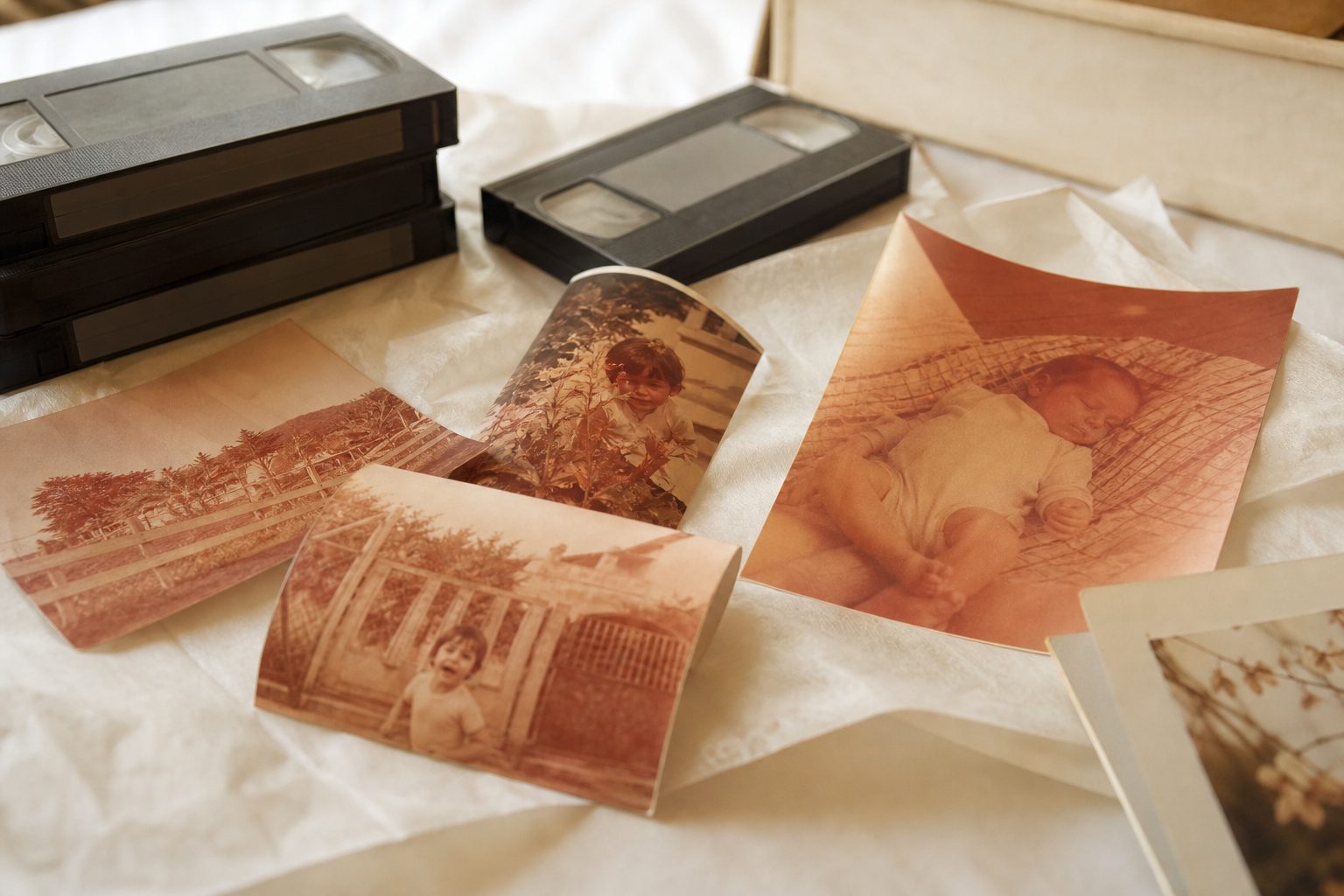
Thirty years in a hot garage does different things to different materials, and knowing which is which decides your triage order. Color prints and slides lose dye, usually the cyan layer first, which is why so many garage boxes come out orange or magenta. Acetate based film shrinks, curls and turns acidic, a chemical process called vinegar syndrome that you smell before you see. Magnetic tape absorbs moisture, the binder that holds the oxide to the base breaks down, and the tape becomes sticky and sheds when played. Self adhesive albums cook their glue solid and bond prints to the page.
Most of it is still recoverable. Faded color prints scan and correct surprisingly well because the dye is diminished, not gone. What is genuinely urgent is the film that has started to off gas and the tape that has begun to hydrolyze, because both are actively getting worse and one of them contaminates its neighbors.
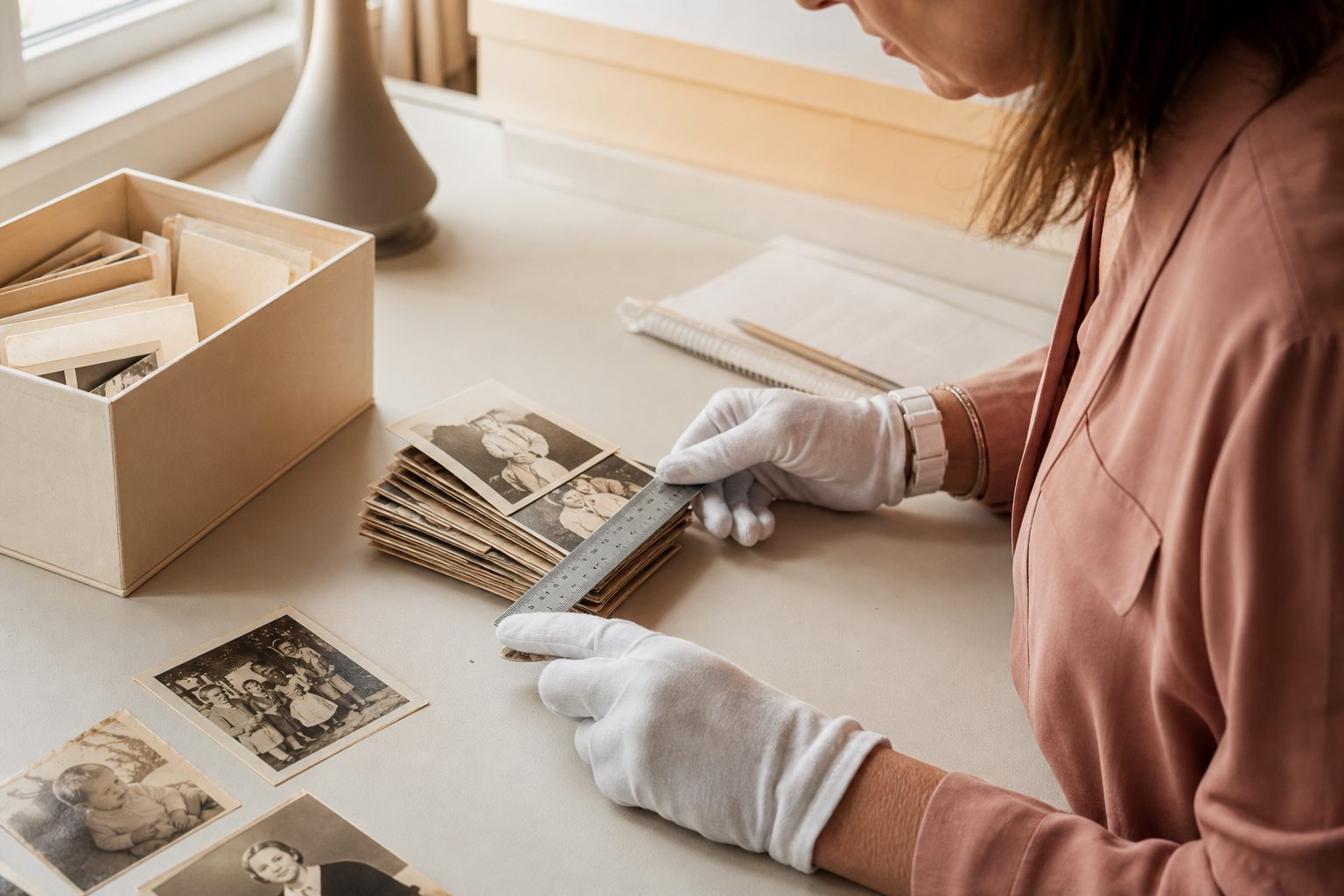
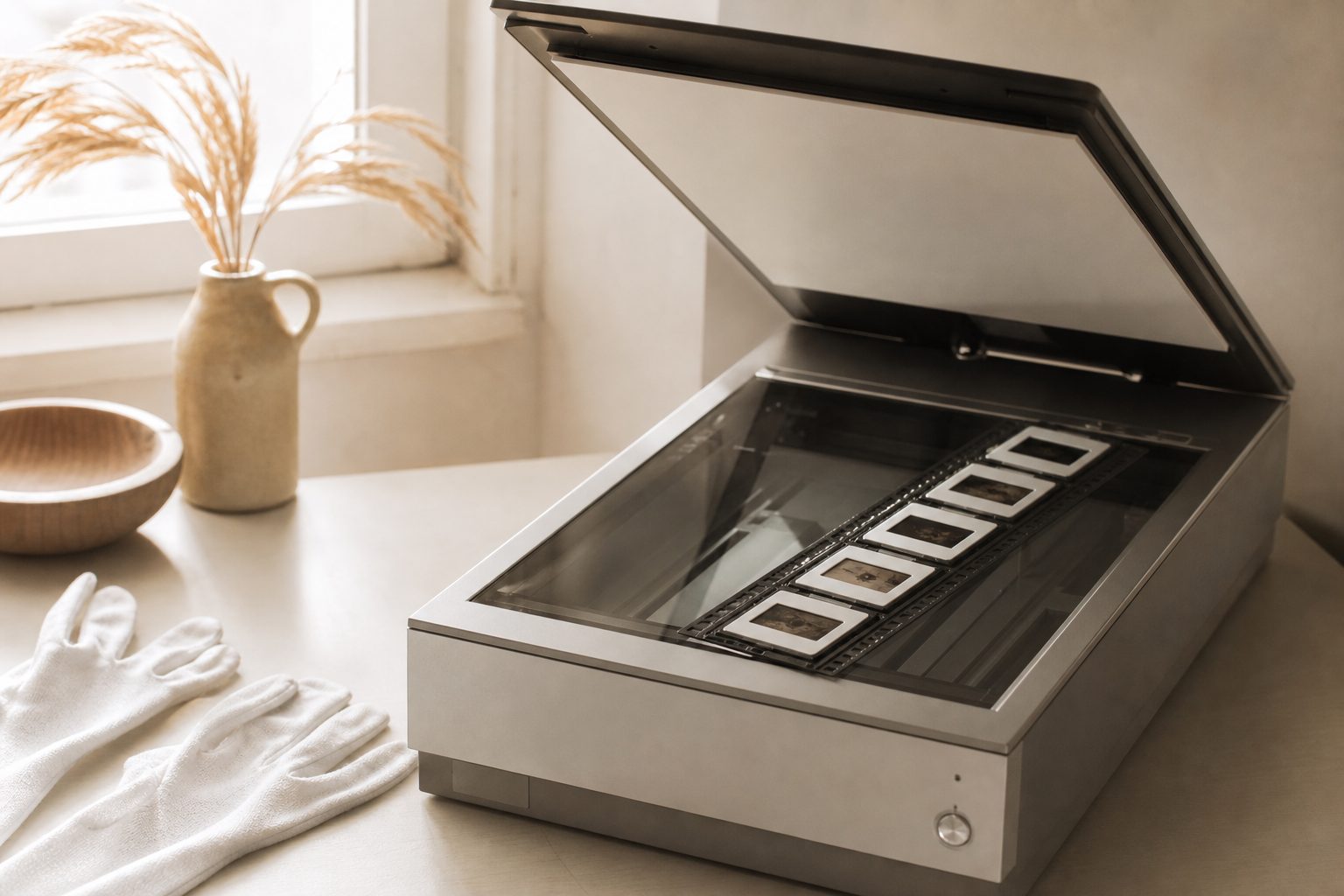
These are field notes from collections that arrived out of garages, attics and basements, organized in the order you should work through them.
Temperature and humidity: the two variables behind every failure
Chemical reactions roughly double in rate for every increase of about 10 degrees Celsius, which is 18 degrees Fahrenheit. That is the reason a garage is so much worse than a closet. A collection at a steady 90 degrees is not slightly worse off than one at 70. It is deteriorating several times faster, every day, for thirty years.
Humidity does separate damage. Above roughly 65 percent relative humidity, mold becomes viable on gelatin emulsion and on paper. Below about 30 percent, film base and paper embrittle and curl. The range you want for long term storage is cool and moderately dry, and stability matters as much as the number.
Cycling is the quiet killer. A garage swings from below freezing to over 100 degrees across a year. Every cycle expands and contracts layers at different rates: emulsion against paper base, oxide against polyester. That is what produces curl, flaking and delamination, not any single hot afternoon.
What this tells you at intake
Ask two questions. Where was it stored, and was that space conditioned. An attic in Phoenix and a basement in Seattle produce almost opposite damage profiles: the attic gives you fading, brittleness and curl, the basement gives you mold, blocking and water staining. Knowing which you are facing before you open the box changes how you handle it.
Keep reading: Is bulk scanning still worth building my studio around, or should I sell organizing instead?
Color dye fading in prints and slides, and why some eras fade faster
Chromogenic color prints and slides hold their image in three organic dye layers. Those dyes are not stable. They fade at different rates from each other, which is why the shift is toward a color cast rather than an even lightening.
Era matters, and the reason is manufacturing chemistry rather than anything the family did. Consumer color prints from roughly the 1950s through the 1970s used dye sets considerably less stable than what came later. Prints from the 1990s frequently look far better than prints from 1968 two pages away in the same album. That is why a client's childhood pictures look worse than her wedding pictures.
Slide film splits too. Kodachrome, whose dyes are added during development, is notably stable in dark storage and often scans beautifully. Ektachrome and other E process films from the same decades commonly show pronounced color shift under identical conditions. Sorting a carousel by film stock before setting scanner profiles saves real correction time.
What scanning recovers
A faded print still carries differentiated density in the surviving layers. Capture flat rather than correcting on the scanner, and do color work on the file where it is reversible. What you cannot recover is a layer faded to nothing, which shows up as a channel with no separation. Set expectations at intake by scanning three representative prints and showing the client the result.
Vinegar syndrome in acetate film and how you recognize it
Cellulose acetate film base degrades by hydrolysis, releasing acetic acid. That is the vinegar smell. It is autocatalytic: the acid produced accelerates the reaction, so it starts slowly then runs.
Recognize it in order of progression: a sharp vinegar odor on opening the can, then curl and shrinkage, then buckling and channeling of the base, then a crystalline bloom. Affected film shrinks by a few percent, enough that it no longer sits flat in a carrier and sprocket registration fails on a transfer machine.
Three rules that matter more than anything else you do with it:
- Isolate it immediately. The off gassing accelerates degradation in neighboring reels and cans. Do not put an affected reel back in a box with healthy ones.
- Vent it. Sealed metal cans trap acid and speed the reaction. Loosen or replace with vented storage.
- Get it cold. Cold storage slows it dramatically. It is the only intervention that meaningfully buys time.
Vinegar syndrome cannot be reversed. Digitization is the preservation step, and it moves to the front of your queue.
Mold, blocking, and prints stuck together in stacks
Damp storage produces two problems that look similar and are handled very differently.
Mold appears as fuzzy or powdery growth, gray, green or white, usually with a musty smell and spreading stains. It is a health matter and a contamination matter. Isolate the box, work ventilated, wear an N95 and nitrile gloves, and do not brush spores around a studio holding other clients' materials. If growth is active rather than dormant and dry, controlled drying comes before any cleaning.
Blocking is mechanical. Gelatin emulsion softened by humidity, then pressed under the weight of a stack, bonds print faces to the backs of their neighbors. The stack comes out as a brick. Never force it. Pulling apart blocked prints strips emulsion and takes the image with it, permanently.
Keep reading: How do I price a shoebox scanning project when I have no idea how many photos are inside?
Magnetic tape: binder breakdown, sticky shed, and why playback is urgent
VHS, Hi8, MiniDV and audio cassette all share a construction: magnetic particles held to a plastic base by a polymer binder. Many binder formulations absorb moisture and break down by hydrolysis, the same chemistry family as vinegar syndrome. The result is sticky shed: the tape squeals, drags, sheds oxide onto the heads and guides, and can seize.
This is the most time sensitive category in an average family collection, for a reason beyond chemistry. The playback equipment is out of production. A tape you cannot play is not an archive, it is an object, and the pool of working decks and the technicians who service them shrinks every year.
Handling rules for garage tape:
- Acclimate before playing. Bring the tape to room conditions slowly over a day or more. Playing cold tape straight from a hot or damp box invites condensation and shedding.
- Inspect the pack. Uneven winds, popped strands and a stepped pack edge mean tension trouble. A retension pass on a known good machine beats discovering it mid transfer.
- Listen on the first pass. Squeal means stop. Continuing grinds oxide off and each pass loses image you will never get back.
- Transfer once, well. Treat every play as consumption of a finite resource.
Sticky shed is often treatable by controlled dehydration by a specialist with the right equipment, which is a referral, not a studio kitchen project.
Self adhesive magnetic albums and safe removal options
The three ring albums with tacky card pages and clear plastic overlays, sold heavily from the 1970s through the 1990s, are the most common single problem in American family collections. The adhesive is acidic, it yellows, and over decades it cures from tacky to hard and grips the print.
Work through the escalation in order and stop as soon as a page releases:
- Lift the plastic overlay and try a gentle corner lift with a clean fingertip. Many prints simply let go.
- Slide unwaxed dental floss or thin monofilament under a lifted corner and work it across in a slow sawing motion parallel to the page.
- Try a microspatula worked flat under the print, never levering upward at an angle.
- Try brief, indirect low heat to soften the adhesive, keeping the source away from the emulsion and testing on the least important print on the page.
- If it will not release, stop and scan the print in place through the overlay removed, or scan the whole page.
Scanning a print you cannot safely lift is a completely legitimate outcome. The image is what the family wanted. Losing the emulsion to prove you could get it off the page is not a win.
See how PaperKeepsake handles this for memory keeping and photo organizing services
Triage order when a damaged collection arrives
| Priority | Material | Reason |
|---|---|---|
| 1 | Active mold, wet or damp material | Spreading, contaminates other items, health risk |
| 2 | Acetate film with vinegar odor | Autocatalytic and off gasses onto neighbors |
| 3 | Magnetic tape, especially squealing or sticky | Degrading and playback equipment is scarce |
| 4 | Slides and negatives | Often the only original, high image value per item |
| 5 | Faded color prints | Slow, stable once conditioned, recoverable in scan |
| 6 | Blocked stacks and adhesive albums | Mechanical, not accelerating, needs patience |
Isolate before you inventory. The first physical action on a garage collection is separating anything that smells of vinegar or mold from everything else, into its own vented containers, before a single item goes on your intake table.
When to refer to a conservator instead of proceeding
Refer out when the material is wet, when mold is actively growing rather than dormant and dry, when prints are blocked and the client needs the originals separated, when film is buckled or crystallized rather than merely smelly, when tape squeals on a test pass, and any time the item is unique, valuable and fragile at once. A photograph conservator through a professional conservation association is the right referral, and making it early protects your reputation far more than attempting it protects your invoice.
Turning a damaged collection into a usable archive
Triage is only half the job. The other half is that the family ends up with something searchable rather than a folder of thousands of files named by scanner sequence, which is where a lot of rescued material quietly disappears a second time.
PaperKeepsake is built for that half: scanning batches that stay tied to the box and envelope they came from, date and person tagging as you work, and a shareable family index at the end. Set up the project at intake, log condition notes against each batch, and the triage decisions you made on day one are still visible to the family years later.