numbers and benchmarks
How do I price a shoebox scanning project when I have no idea how many photos are inside?
Unknown volume is the core estimating problem in photo organizing. Here is how to structure a two stage quote, use a paid assessment, and set per image and hourly rates that survive a surprise.
You price it in two stages, and you charge for the first one. A shoebox is an unknown, and the only honest way to quote an unknown is to get paid to open it, count what is actually inside, then issue a real number against what you found. Anything else is you absorbing the risk of a collection you have never seen.
The practical structure looks like this: a paid assessment at a fixed fee, a written estimate expressed as a range with a stated count assumption, and a change order clause that triggers when the real count lands outside that range. The assessment fee gets credited toward the project if the client proceeds. That single move converts your riskiest guess into billable work.
Everything below is the machinery that makes those two stages hold up when the client says four shoeboxes and you find eleven boxes, three water damaged albums, and a coffee can of slides.
Why flat per project quotes fail on loose print collections
A flat quote is a bet that your count estimate is accurate. On loose prints, that estimate is almost always wrong in the same direction: low. Clients underreport because they are describing the boxes they can see, not the ones in the attic, and because a box of loose 4x6 prints holds far more than people picture.
The failure mode is not really the scanning. Scanning is the most predictable part of the whole job. The failure is in handling: separating stuck prints, removing corners and tape residue, unfolding, sorting duplicates, deciding what is a keeper. That work scales with the count, and the count is what you did not know.
There is a second reason flat quotes fail. When you have quoted flat and the volume doubles, you have only two moves left, and both damage you. You eat the hours and the project becomes your worst paying job of the year, or you go back to the client mid project with a number they did not agree to. A range plus a change order clause lets you have that conversation on paper before the first print is touched.
Keep reading: What resolution should I actually scan family prints and slides at for a client archive?
Running a paid assessment visit and what it should cover
Price the assessment as a small fixed engagement, not an hourly open ended thing. A typical shape is a flat fee covering up to two or three hours on site plus the written estimate afterward. Say plainly that the fee is credited against the project if they book within some window, thirty or sixty days.
What you are actually doing in those hours:
- Opening and physically measuring every container, not just the ones the client mentioned on the phone.
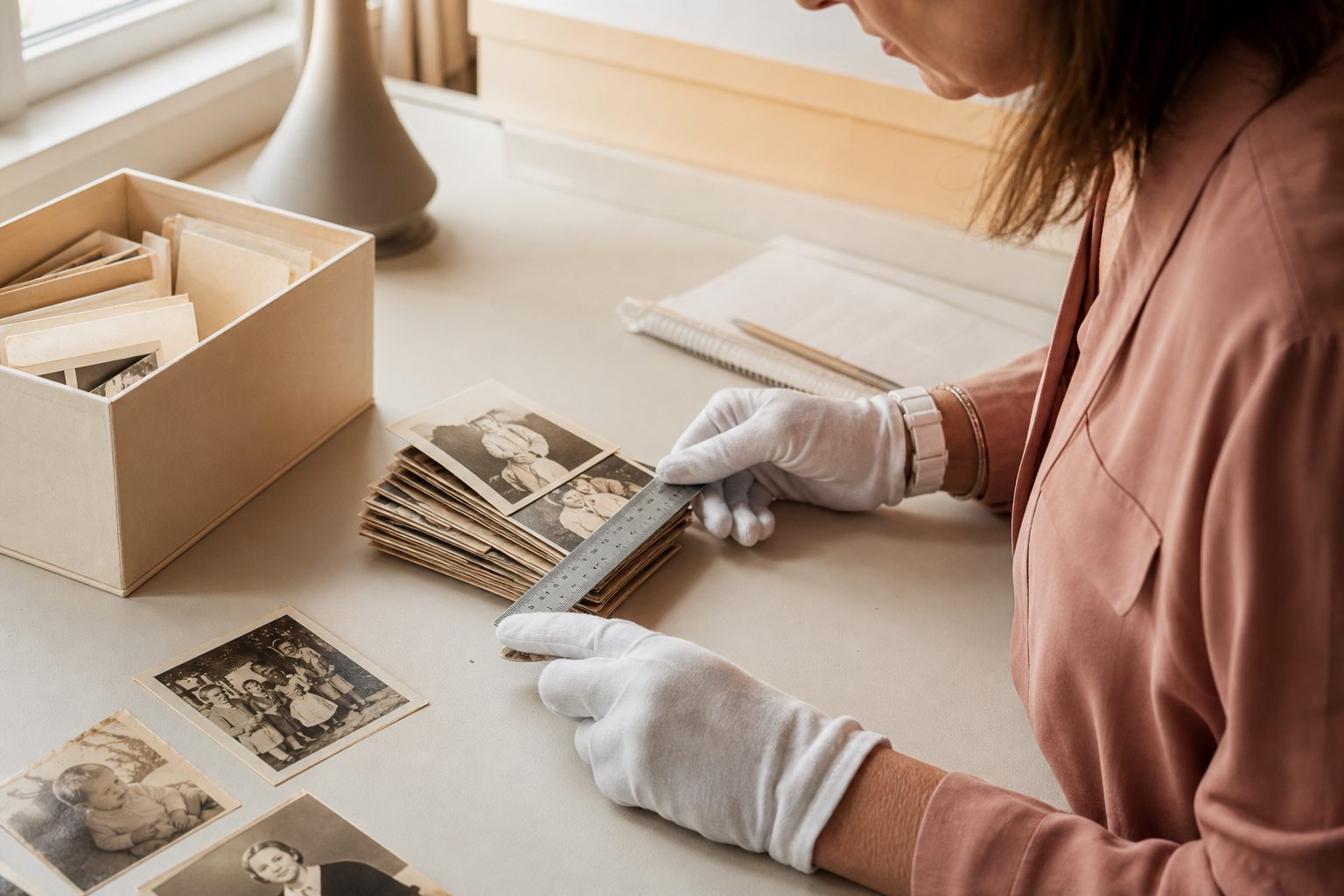
- Sampling: pull a measured section from three or four different boxes and count it precisely, so your per inch figure comes from this collection rather than a general rule.
- Identifying format mix: standard prints, oversize, mounted studio portraits, Polaroids, slides, negative strips, bound albums, magnetic albums.
- Flagging condition problems: mold smell, stuck blocks, curl, brittle edges, tape, adhesive album pages.
- Asking what the deliverable actually is. Every image, or a curated archive? Names and dates attached, or files only?
- Photographing the collection as found, which protects you later on condition disputes.
Leave with measurements written down, not impressions. The whole point of the visit is to replace adjectives with inches.
Estimating count by linear inch, album page, and box volume
Loose prints of a single size stack at a fairly consistent density, so linear inches is the workhorse method. You measure the depth of the stack, multiply by your prints per inch figure, and you have a count.
Do not borrow a prints per inch number from a blog, including this one. Derive it on site. Here is the method, with the arithmetic shown so you can redo it with your own numbers.
- Square up a section of prints from the actual collection.
- Measure exactly one inch of that section with a ruler and count the prints in it. Say you count 110.
- Repeat in two other boxes. Say you get 96 and 118.
- Average them: 110 plus 96 plus 118 equals 324, divided by 3 equals 108 prints per inch.
- Measure total stacked inches across all containers. Say 62 inches.
- 62 times 108 equals 6,696 prints.
Those are illustrative numbers, not benchmarks. Thicker older stock counts lower per inch, modern lab prints count higher, and anything with mounts or sleeves counts far lower. That is exactly why you sample instead of assume.
For bound and magnetic albums, count pages and images per page instead. Open the album, count images on five representative pages, average, multiply by filled page count. A magnetic album with a consistent layout is one of the easier things to estimate; a scrapbook where every page is different is one of the hardest, so sample more pages there.
For sealed or inaccessible boxes, fall back to volume. Note the interior dimensions, estimate the fill fraction honestly, convert to stacked inches, and label that container as an estimate rather than a measurement in your notes. When you write the proposal, say which containers were measured and which were estimated.
Keep reading: Flatbed, photo feeder or camera copy stand: which capture setup fits my studio workload?
Per image versus hourly versus day rate, and when each fits
Most studios end up using all three on different parts of the same project. The question is which unit matches the work.
| Unit | Fits when | Breaks when |
|---|---|---|
| Per image | Uniform loose prints, one or two sizes, capture is the dominant task | Heavy condition problems, mixed formats, or lots of judgment per image |
| Hourly | Sorting, culling, tagging names and dates, album disassembly, repair adjacent handling | Client wants a firm total and cannot tolerate an open number |
| Day rate | On site work, large estates, jobs where you cannot remove originals | Small projects where a day is more than the work needs |
A clean hybrid quote reads: per image capture rate for the scanning, hourly for prep and metadata with an estimated hour band, and a fixed fee for the final index and delivery. The client sees three lines and understands what drives each.
Sanity checking your per image rate
Take your target hourly figure and divide by realistic throughput. If you want an effective 75 dollars per hour on capture and your station genuinely produces 180 usable images per hour including loading and file checks, that is 75 divided by 180, about 42 cents per image. If your true throughput is 90 per hour because the prints are mixed sizes, the same target rate needs about 83 cents. Nothing about the price list changed, only the reality of the material.
Building sort and cull time into the number, not the scan time
The most common estimating error in this trade is treating a project as a scanning project. Capture is often the minority of the hours. Sorting, deduplicating, orienting, unsticking, and deciding what does not get scanned all happen before an image ever hits the glass.
Estimate prep separately and in its own unit. A workable habit is to express prep as hours per thousand images based on condition tier, established from your own past jobs:
- Clean tier: loose, uniform, no adhesive, minimal duplicates.
- Standard tier: mixed sizes, some envelopes and negatives interleaved, moderate duplicates.
- Difficult tier: magnetic albums, tape, curl, stuck prints, unlabeled mixed decades.
Assign the tier during the assessment, write the tier into the proposal, and state that a tier change is a change order trigger. Now the client is not surprised, and you are not silently absorbing four extra days of album disassembly.
Culling deserves its own line because it is a decision service, not a labor service. If the client wants you to reduce 7,000 images to a curated 2,500, that is skilled work and it is billed hourly, and it should happen before capture so you are not paying to scan what gets deleted.
See how PaperKeepsake handles this for memory keeping and photo organizing services
Surcharges that are fair to name up front
Surcharges feel awkward until you realize the alternative is hiding the cost inside a higher base rate that penalizes simple collections. Name them, price them, and put them in the proposal even when you do not expect to use them.
- Odd and oversize originals that exceed your standard platen and need stitching or copy stand capture.
- Mounted and cased items: studio portraits on board, framed prints, cased daguerreotype style pieces that cannot be pressed flat.
- Film: slides, 35mm negative strips, medium format, all of which are a different capture path and a different per unit price.
- Adhesive album removal, priced per page or hourly, because time per page varies wildly.
- Deep metadata: identifying people, dating images, transcribing writing on the back. Always hourly.
- Rush turnaround, expressed as a percentage uplift on the whole project rather than a flat add.
Writing the estimate range and the change order clause
Write the count assumption into the document as a number, not as a description. Something like: this estimate assumes approximately 6,700 loose prints in standard condition tier, measured across 62 stacked inches on the assessment date.
Then bracket it. A plus or minus band of roughly ten to fifteen percent is a reasonable working tolerance when you measured most of the containers yourself, and wider when you had to estimate sealed boxes. State the band and state what happens outside it: images beyond the upper bound bill at the same per image rate, and a condition tier change is repriced before the affected work begins, with written approval.
Add two more protections. First, a discovery clause covering new containers found after the assessment, because attics keep producing. Second, a stated deliverable definition, since scope creep in this trade usually arrives as extra metadata rather than extra images.
Where to put the numbers once you have them
An estimate is only as good as your ability to track the real counts against it. If your assessment says 6,700 and you have no running total until delivery day, you find out you were wrong at the worst possible moment.
PaperKeepsake is built around exactly this: client archive projects with scanning batches, so each box you work becomes a batch with a real count, date and person tagging that turns metadata work into visible progress, and a shareable family index at the end. Set the project up with your assessment number as the target, and every batch you close tells you whether the change order conversation is coming. That is the difference between quoting a shoebox and knowing what is in it.