regulation and compliance
What does a photo organizing contract need to say about loss, damage and the client's originals?
You take custody of irreplaceable property. Here is what a service agreement should cover on bailment, limits of liability, chain of custody, insurance, and what happens if a box is damaged.
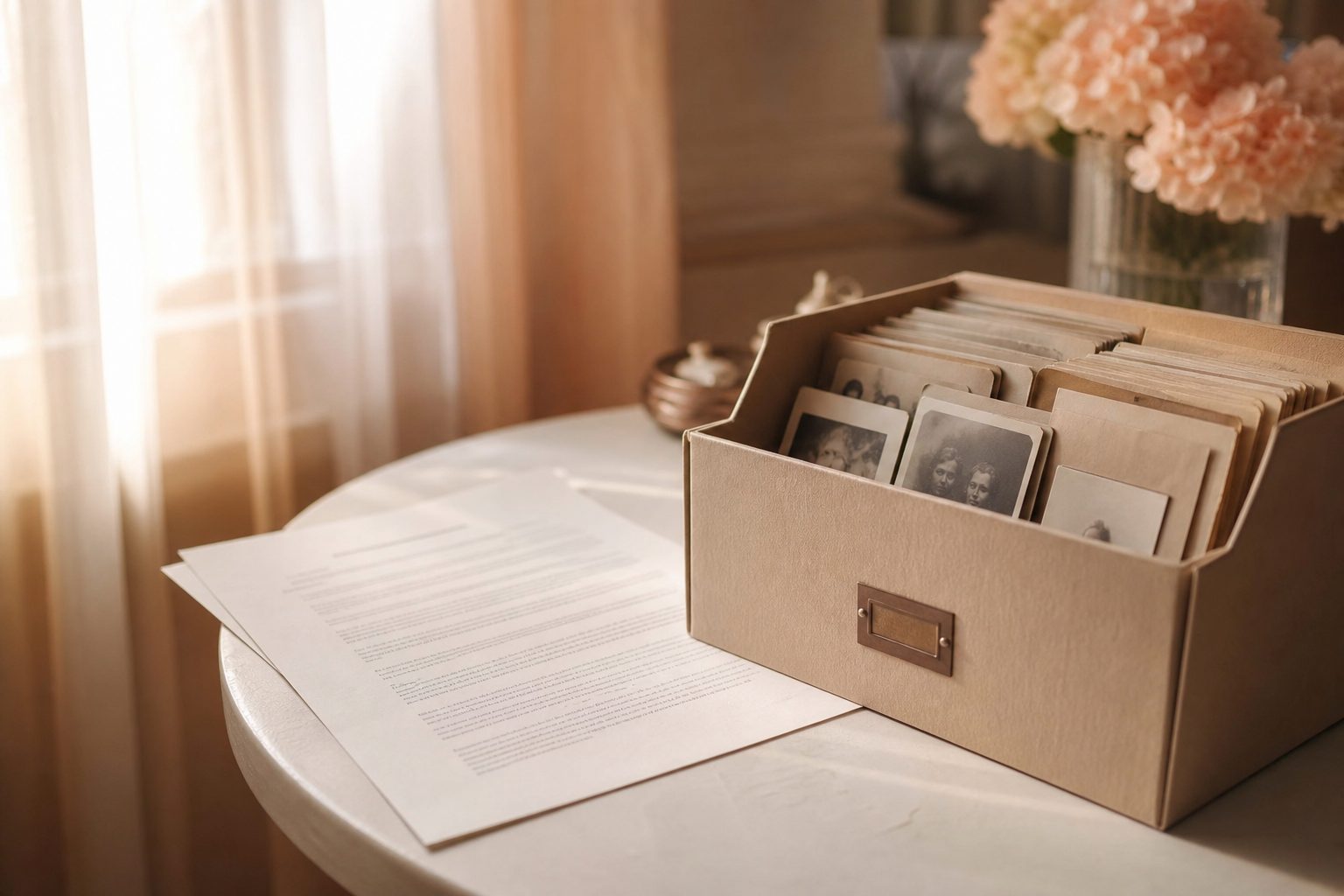
A photo organizing agreement has to do one thing that most service contracts never have to do: govern the temporary transfer of physical property that cannot be replaced at any price. So the contract needs a custody section, not just a scope section. At minimum it should state that you are holding the client's property as a bailee, describe how the property is counted in and counted out, cap your liability at a stated dollar figure, name who insures what, and say what happens to boxes still in your studio when the client stops answering email.
What follows is a map of the clauses that matter in this trade and what a reasonable version of each does. It is not legal advice and not a substitute for an attorney licensed in your state. It is the vocabulary that makes the attorney conversation take forty minutes instead of three hours.
Bailment: what taking custody of a client's property means
When a client hands you four boxes of prints and you take them back to your studio, you have created a bailment. That is the common law term for possession of someone else's personal property without transfer of ownership. You are the bailee. The client is the bailor. The property is the bailed goods.
The reason this matters is the standard of care attached. Where the bailment benefits both parties, which is the case any time you are paid to work on the goods, courts generally expect ordinary reasonable care. You are not an insurer of the property. But you are responsible for negligence, and in many states a presumption runs against the bailee: if goods go in undamaged and come out damaged or missing, the burden lands on you to explain how that happened without fault on your part.
That presumption is the single most important reason to keep records. Without them, "I don't know what happened to box three" is not a defense.
What to put in the clause
State plainly that the client retains ownership of all originals, that you take possession solely to perform the described services, and that you will exercise reasonable care consistent with common practice for archival materials. Describe your storage in one sentence. If client boxes live in a locked interior room away from exterior walls and water lines, say so. It is both a selling point and a description of the care you promised.
Keep reading: Who owns the copyright when I scan a client's old studio portraits and wedding photos?
Scope, deliverables, and defining a completed project
Vague scope is where these projects die. A family archive has no natural boundary, and there is always another album at an aunt's house. Define the project by countable units, not by outcome adjectives. "Organize the family photos" is unbounded. "Scan up to 3,200 loose prints from the six boxes inventoried on Schedule A at 600 ppi TIFF, apply date and person tags per the agreed naming standard, and deliver on two portable drives plus a shareable index" is a project with an end.
Your agreement should carry:
- An intake schedule listing containers by number, contents description, and estimated item count
- The scan resolution, file format, and color handling you are committing to
- A stated change order process with an hourly rate for material found outside the inventoried containers
- A definition of acceptance: for example, the project is complete on delivery of the drives and the index, with a stated review window for correcting errors
- A return date for originals, tied to delivery rather than to an open ended "when convenient"
The review window is worth arguing for. Fourteen or thirty days of correction on tagging errors is generous and finite. Without it, a client can reopen a two year old project because a cousin was mislabeled.
Limits of liability and why irreplaceable is a pricing problem
Here is the honest arithmetic. Say the project fee is $4,800 and the boxes hold roughly 3,000 prints, several dozen of them unique family images from before 1930. If a studio fire destroys them, the market value of the paper is near nothing and the value to the family is unbounded. There is no fee at which you can rationally accept unlimited exposure on that.
So contracts in this trade almost always carry a limitation of liability. Common shapes:
| Cap structure | Example | Note |
|---|---|---|
| Fees paid | Liability capped at amounts paid under this agreement | Most common, simple to administer |
| Fixed dollar figure | Capped at $5,000 regardless of fees | Predictable, easier to insure against |
| Per item | A stated amount per print or per container | Rare in this trade, hard to price |
Two practical points. Most versions also exclude consequential and sentimental damages, and many states will not award sentimental value for personal property in any case, though that varies. And limitation clauses are generally not enforceable to excuse gross negligence or willful misconduct, with some states restricting them further. That is a question for your attorney, not a template.
The mitigation that actually protects the client
Scan early, scan the rarest material first, and keep a working copy on separate media before originals travel anywhere. A liability cap protects your business. A digital surrogate made in week one protects the family. Say in the contract that you scan in priority order. It turns the risk conversation from adversarial to shared.
Keep reading: How should I name files and tag people so a family can still search the archive in twenty years?
Chain of custody records from pickup to return
This is the part that carries you through the bailment presumption. Build the paper trail as a routine, not as a reaction.
- Pre-pickup photographs. Shoot every container in place at the client's home, closed and then open, with a visible label card.
- Numbered container labels. Assign a project code and sequential container numbers. Never reuse a number.
- Signed intake receipt. Container count, description, estimated item counts, condition notes including existing damage, mold, or adhesive album pages. Both parties sign. The client keeps a copy.
- Transport log. Date, who moved it, vehicle, and whether the load was ever left unattended.
- Studio location log. Where each container sits, updated when material moves to a scanning station.
- Batch records. Which container fed which scanning batch, and where the resulting files live.
- Signed return receipt. Container count and condition at handoff, with the same photograph routine.
Note existing damage loudly at intake. Water staining, silverfish tracks, vinegar syndrome on acetate negatives, and crumbling magnetic album pages all predate your arrival, and all get blamed on whoever touched the box last.
Insurance to ask your broker about
Your general liability policy almost certainly does not cover the client property in your care. That is a standard exclusion in commercial general liability forms, sometimes phrased as care, custody, or control. Read yours before you assume otherwise.
Take this list to a commercial broker and ask specifically:
- Bailee coverage, sometimes written as a bailee's customers form or an inland marine floater, covering client property while in your possession and in transit. Ask about the per occurrence limit, the deductible, and whether transit in your own vehicle is included.
- Commercial general liability for bodily injury and property damage at client sites, which matters because you work in other people's homes.
- Professional liability for errors in the service itself, such as a mistagged or lost delivery set.
- Cyber liability, because a family archive is a large pile of personal images and, increasingly, scanned documents with dates of birth and Social Security numbers on them.
- Business property for your own scanners and drives, which is not the same coverage as the client property line.
Ask whether coverage applies off premises, whether there is a sublimit for property left in a vehicle overnight, and what records the policy requires of you. Some bailee forms condition payment on an itemized receipt system, which is another reason the intake receipt is not optional.
See how PaperKeepsake handles this for memory keeping and photo organizing services
Abandoned property, unpaid balances, and holding originals
Every studio eventually has a project that goes quiet. The client stops replying, the balance is unpaid, and six containers occupy a shelf that should be earning revenue.
Write the sequence into the agreement in advance:
- A storage fee that begins a stated number of days after you notify the client that originals are ready for return, with the daily or monthly amount named
- A written notice procedure, including the address of record and the client's obligation to keep it current
- A stated period, in months, after which unclaimed property falls under the abandonment terms
- An acknowledgment that you may hold digital deliverables until payment clears
Two cautions. Holding the client's original prints as leverage for an unpaid invoice is a very different thing from holding your own digital files, and asserting a lien on someone else's personal property is governed by state statute. Ask your attorney what your state allows before you rely on it. Separately, unclaimed property may fall under your state's escheat rules, and disposal of family photographs is a decision no one wants to make from a template.
Getting the agreement reviewed by an attorney in your state
Contract law here is state law. Bailment standards, enforceability of liability caps, lien rights, and abandonment procedure all vary. A document that works in Ohio may be partly unenforceable in California.
Make the review efficient. Bring a draft rather than a blank page, and bring the operational facts the attorney needs: how many containers a typical project involves, whether you transport in your own vehicle, whether subcontractors ever touch originals, what your storage looks like, and what your insurance currently covers. Ask directly which clauses your state will not enforce as written, and ask for the fallback wording.
Budget for it as a fixed cost spread across every project you will sign for the next several years. On a studio signing twenty projects a year, a one time review amortized over three years is a few dollars per project. That is cheap next to one disputed box.
Where the contract meets the work
A good agreement is only as strong as the records behind it. The clauses about custody, condition, and completion all assume there is a container log, a condition note, a batch record, and a delivery index you can produce on demand.
That is exactly what PaperKeepsake is built to hold. Client archive projects keep the container inventory, the scanning batches, and the date and person tagging in one place, so the intake receipt, the batch trail, and the shareable family index all come from the same record rather than from three spreadsheets and your memory. Write the contract with your attorney, then run the project so the paperwork it promises actually exists.