case study
Why do my clients keep stalling at the sorting stage, and how do I move the project forward?
A composite look at three stalled family archive projects, what actually caused each delay, and the working changes that unstuck them without discounting the fee.

Clients stall at sorting because sorting is the only stage where you hand the decisions back to them. Scanning is yours. Tagging is yours. Sorting asks a person to look at four hundred pictures of people who are dead and say which ones matter. That is not a scheduling problem or a motivation problem. It is a decision load problem, and it is fixable by changing how you present the decisions, not by sending another gentle follow up email.
The fix has three parts. Cut the number of choices per session to something a tired person can finish. Put the client and the photographs in the same room at a scheduled time instead of leaving a box on their dining table. And bill so that stalling costs the client money before it costs you money.
What follows is a composite of three projects, details changed and combined, that each stopped at the same stage for a different underlying reason. The pattern that connects them is worth more than any one of the stories.
Project one: too many decisions handed to the client at once
A retired teacher brought in six banker boxes of loose prints spanning 1958 to 2004. Intake went well. She was engaged, she knew the names, she was excited. Then the studio delivered a first pass of unsorted scans and asked her to review 2,800 images in a shared folder and mark keepers.
Eleven weeks of silence.
When she finally answered the phone, she was apologetic and specific. She had opened the folder four times. Each time she got about ninety images in, hit a run of near duplicates from a 1987 camping trip, could not decide which of the seven nearly identical shots to keep, and closed the laptop.
What actually went wrong
The task had no visible end and no unit of completion. There was nothing that felt like finishing. And the hardest decisions, near duplicate culls, were mixed in with the easiest ones, which are the ones that build momentum.
The change was mechanical. The studio split the folder into batches of roughly 150 images grouped by envelope and rough era, put a plain count at the top of each batch, and pre-culled the obvious duplicates itself using a simple rule: within a burst of visually similar frames, keep the sharpest and any frame where a face is looking at the camera, flag the rest as a set rather than as individual decisions. She was then asked one question per set instead of seven.
She cleared four batches the first weekend.
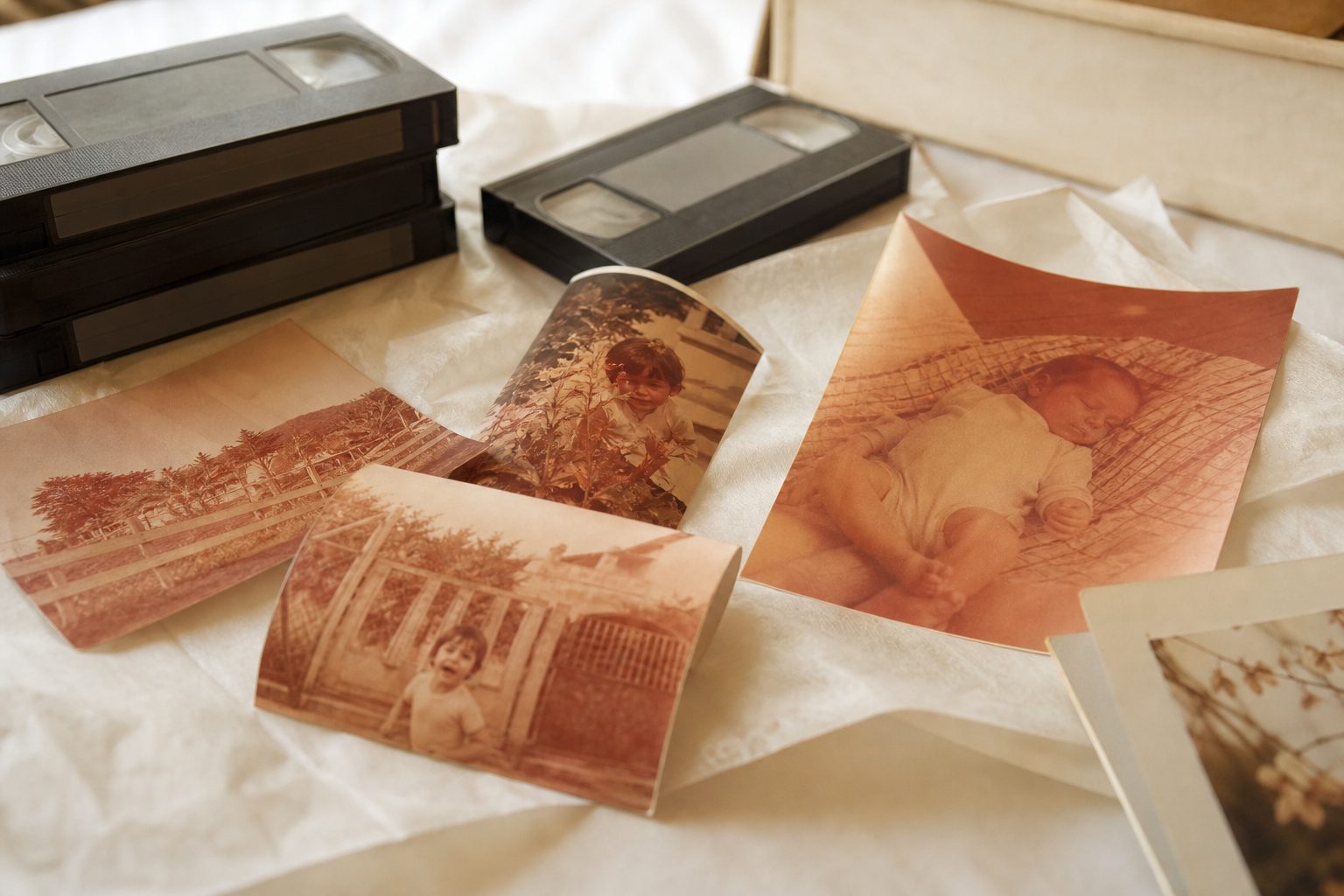
Keep reading: What actually happens to prints, slides and VHS tapes stored in a hot garage for thirty years?
Project two: siblings with competing claims on the same boxes
Three adult siblings jointly hired a studio to digitize their mother's collection while she was still living. The engagement letter named all three as the client. That was the mistake.
Sorting stopped because every decision needed consensus among three people in three time zones who did not agree about what the collection was for. One wanted a slideshow for their mother's ninetieth. One wanted everything preserved with no culling on principle. One wanted the original prints physically divided so each household got a share.
The structural fix
You cannot mediate a family. You can change who signs.
The studio rewrote the arrangement so that one sibling was the named decision maker and point of contact, with the other two receiving copies of everything and no approval rights over the working process. That was put in writing and countersigned by all three. Physical division was moved out of scope entirely and deferred to after digitization, which is the correct order anyway: divide originals after everyone has a full digital set, so no one loses access to a picture by losing the print.
The culling disagreement dissolved on its own once the studio proposed keeping everything at archival resolution and building the slideshow as a curated subset. Nobody had to lose. The decision maker chose the subset.
Project three: grief and why the work stopped after a death
A widow started a project four months after her husband died. She was organized, she paid the deposit promptly, and she stopped answering entirely after the second working session.
There was no process failure here. She hit the hospital pictures.
This happens often enough that it deserves a plan rather than improvisation. What worked was a short, direct call that did not pretend the problem was logistics: the studio said plainly that this stage is hard, that plenty of clients need to pause, and offered three options. Pause the project for a defined period with the collection either returned or held. Continue with the studio doing all handling and the client reviewing only a curated set at the end. Or have an adult child or friend sit in on sessions as a second pair of eyes.
She chose the third. The project finished five months later than planned and she referred two neighbors.
The operational point
Have a written pause policy before you need it. Ours specifies a maximum hold period for physical materials, what storage conditions the studio provides, and what happens to the deposit. Improvising that conversation while a client is crying is bad for both of you.
Keep reading: Is bulk scanning still worth building my studio around, or should I sell organizing instead?
The common pattern: decision load, not motivation
In all three, the client wanted the outcome. None of them lost interest. What stopped them was being asked to make more decisions per unit of time than they could carry, whether the weight came from volume, from family politics, or from grief.
So design the sorting stage around decision count, not image count. A workable rule of thumb from practice: a client in a scheduled session can make roughly one meaningful keep or cut decision every five to eight seconds on easy material, and far fewer on emotionally loaded material. At six seconds, a ninety minute session is about 900 decisions if nothing is hard. Assume half that, because something always is. That is your realistic session capacity, and it means a 3,000 image collection is four or five sessions, not homework.
Those numbers are working assumptions from studio practice, not measured research. Time your own sessions and replace them with your real figures.
Milestone billing and deposits that keep the project moving
A single deposit at the start plus a balance at the end puts all the pressure on you. Milestone billing moves it.
| Milestone | Share of fee | Trigger |
|---|---|---|
| Intake and inventory | 25 percent | Signed scope, materials received and counted |
| Scanning complete | 35 percent | All batches captured and quality checked |
| Sorting and metadata sessions | 30 percent | Billed per session, invoiced monthly |
| Delivery and index handoff | 10 percent | Final archive and family index delivered |
Billing the sorting stage per session rather than as a lump at the end does two useful things. It makes a skipped session visible on an invoice, and it stops you from carrying months of unbilled labor while you wait. Add a storage fee that begins after a stated number of days past the scheduled completion date, disclosed at signing, and stalling stops being free.
See how PaperKeepsake handles this for memory keeping and photo organizing services
Scheduling working sessions instead of asking for homework
The single highest leverage change is this: stop assigning review as homework and start booking it as an appointment, in person or on video, with you driving.
- Book the next session before the current one ends. Never leave a project with no date on the calendar.
- Cap sessions at ninety minutes. Fatigue makes people either keep everything or dismiss everything, and both are expensive later.
- Share your screen and control the pace. You advance, they say keep, cut, or ask. They should never be alone with a folder and a mouse.
- Start each session with an easy batch. Weddings and holidays before unlabeled 1970s slides.
- Capture names and dates by voice as you go. The client says "that is Aunt Ruth on the porch in Duluth" and you type it. Do not send a spreadsheet.
- End with a count. "We named 214 people today and cleared 1961 through 1968." Visible progress is what brings them back.
Closing the project cleanly when the client will not decide
Sometimes none of it works. The client goes quiet for months, the boxes are in your studio, and you have a scanning bay you cannot use.
Have a written escalation path and follow it without drama. A workable sequence: a warm check in at two weeks, a scheduling offer with three specific times at four weeks, a written status notice at eight weeks that states the outstanding balance and the storage fee start date, and at twelve weeks a formal closure letter offering three outcomes.
- Deliver as is. You complete scanning and metadata to the level currently possible, deliver the archive with unnamed material flagged, invoice the balance, and return originals.
- Suspend and store. The project is paused with materials held under a written storage agreement at a stated monthly rate.
- Return and settle. Originals go back, you invoice for work completed, and the file closes.
Deliver as is is usually the right answer and clients are usually relieved to be offered it. An archive with 60 percent of faces named and everything dated to the year is a real asset. Perfect completion was never the deal. Access was.
Where to go from here
Every one of these fixes depends on knowing exactly where a project stands: which batches are captured, which are named, who the decision maker is, and what the client last saw. That is the part PaperKeepsake handles. Client archive projects carry their own scanning batches, date and person tags, and a shareable family index, so a session opens with the next batch already queued and closes with a count you can send.
Set your next stalled project up that way and book the session before you leave the room. The projects that finish are the ones with a date on the calendar.